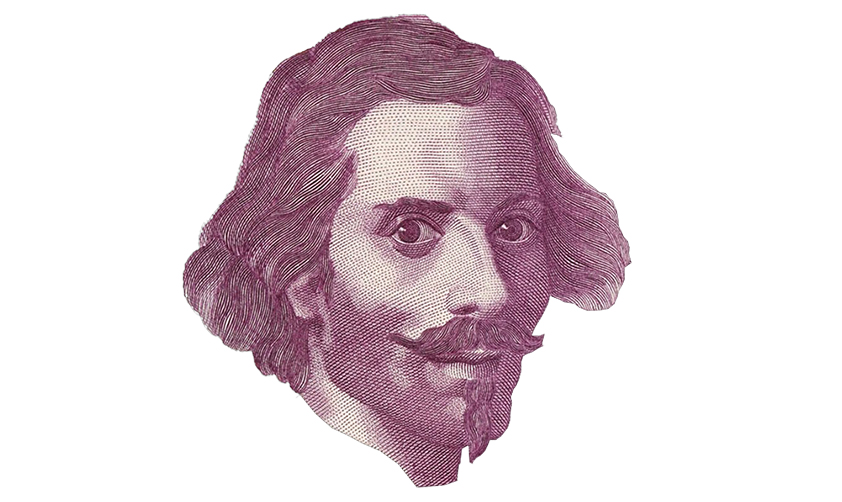

It's easy to laugh at philosophers, all caught up in their abstractions and with their head in the clouds. Thales of Miletus, who lived between the 7th and 6th centuries bce, actually fell into a well while he was busy reasoning about the stars, to the amusement of a woman passing by, a 'teasing and pretty Thracian servant' (Plato, Theaetetus, 174a - 174c). She made fun of the philosopher who was so busy looking up at the sky that he couldn't see what was in front of him on the ground. It seems that it wasn't just this woman, but also a lot of other people in Miletus that mocked Thales; they said that he was reduced to poverty and hardship because of his intellectual work, which was of no practical use whatsoever.
What the serving girl and her fellow citizens couldn't have imagined was that this 'useless' work would soon make Thales rich.
Let's see how, by looking at the tale spun by Aristotle in his Politics.
First of all, we have to bear in mind that the economy of Miletus, an ancient city on the Anatolian peninsula in what is now modern-day Türkiye, was mostly based on the production of olive oil, which was a luxury product at that time. A good olive harvest could mean big profits, not just for the owners of the olive groves but also for the managers of the olive presses. However, if the harvest was poor, then both the owners and the managers had to tighten their belts.
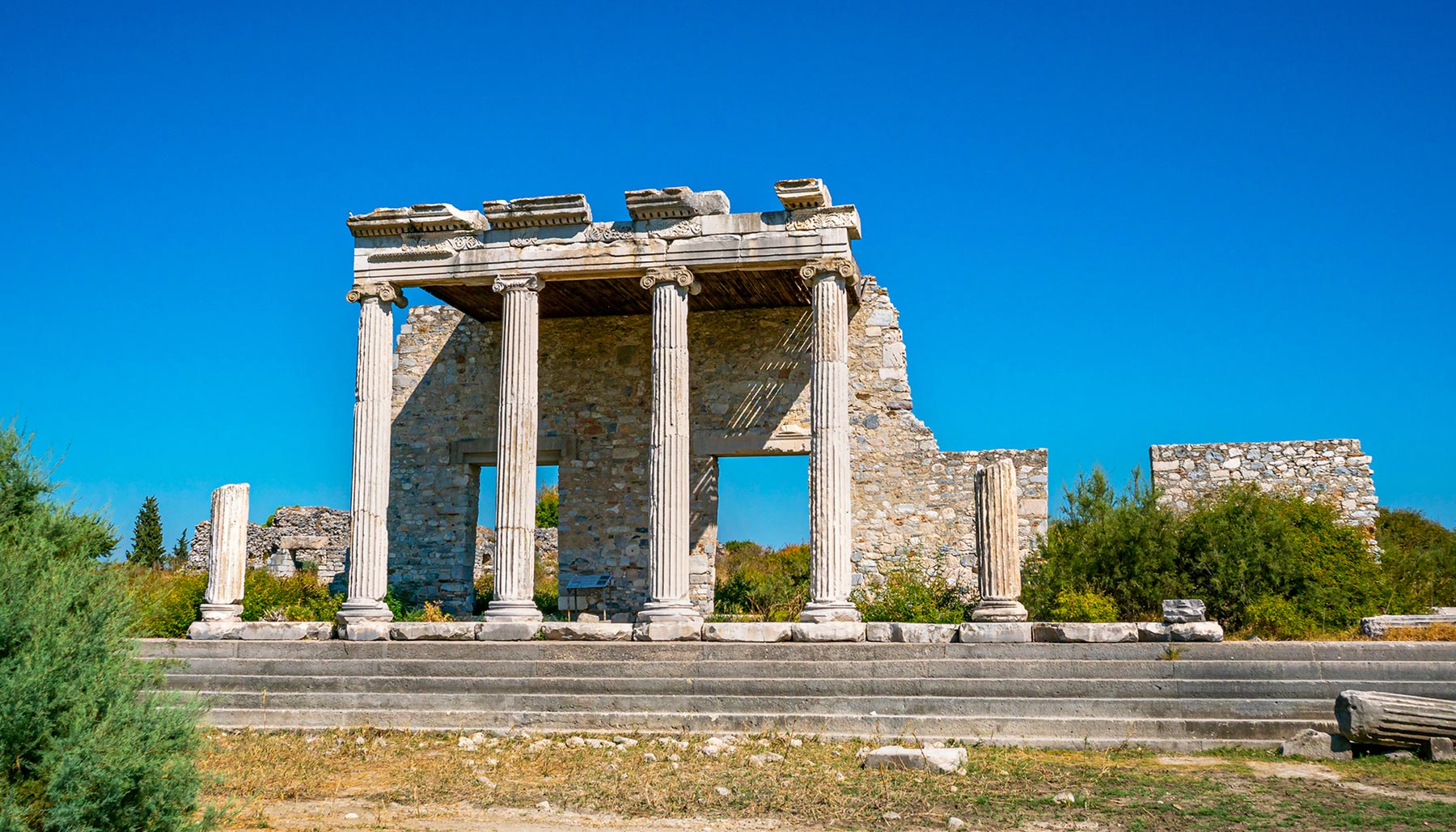
So, using his knowledge of astronomy, which had also enabled him to predict the eclipse of 585 bce, Thales tried to guess what the next harvest would be like, even though it was still the middle of winter, and decided it was going to be a particularly good one. He went to the owners of all the olive presses in Miletus and in the nearby island town of Chios, and proposed that they sold him the right, but not the obligation, to rent their presses at a set price when it was harvest season. In exchange, Thales would pay them a small sum straightaway. The press owners weren't keen on the risk of finding themselves penniless if there was a bad harvest, and were delighted to earn a fee there and then and to grant Thales the right to rent their presses for a set price at harvest time.
Thales' forecast turned out to be right, and the harvest was so good that the demand for olive presses soared. And so it was that the thinker, who had acquired a monopoly over the presses, rented them at the price agreed, and in turn rented them out 'on his terms and so, having earned great riches, he proved that it was really easy for philosophers to get rich if they want to, and yet that's not what they concern themselves with' (Aristotle, Politics, I.11).
This story includes an important lesson on the utility of finance, which almost seems like a parable of vindication for men of intellect. Thales didn't make a good business deal because of his knowledge of astronomy, which really isn't very helpful in predicting a harvest! Thales' fortune was actually made by knowing how best to manage the unpredictability of a future event, using techniques that form the basis of many modern financial products too. Here we're talking specifically about 'financial derivatives'.

We can rewrite the four key parts of the story of Thales' oil presses in modern terms, and show how the philosopher of Miletus set up a financial strategy based on derivatives or, more accurately, on call options:
- Thales analysed the 'harvest market' and estimated an increase in demand for using the oil presses. This is the initial phase for all derived products, which means predicting the price of an underlying asset, which is the oil presses in this case.
- Instead of buying the oil presses (physical assets), Thales came to an agreement with the owners of the local presses. He paid a modest sum for the right, but not the obligation, to rent the presses at a set price in the future (strike price), when demand would go up.
- When it was harvest time and demand for the presses rocketed, Thales exercised his options and rented the presses at the agreed price; he then sublet them at a much higher market price and made a profit based on the difference between the exercise price and the market
- Thales didn't do this to get rich, but to show that philosophical and scientific knowledge could also be applied to rational speculation. In modern terms, it was a form of option-based speculation (a right to the future use of the presses) based on a favourable harvest forecast.

The story of Thales' oil presses shows us how the lack of trust in derived products, in part caused by the great financial crisis in 2008, can be overcome by understanding the logic behind them. Derivatives are not, of course, limited to the basic option exercised by the philosopher from Miletus, and some of them involve such complicated maths that only a few experts understand them. However, learning to manage risks or knowing that there are financial instruments that can help us in this sphere is an advantage that shouldn't be overlooked: it's not in our best interests and it wasn't in those of our ancestors either.