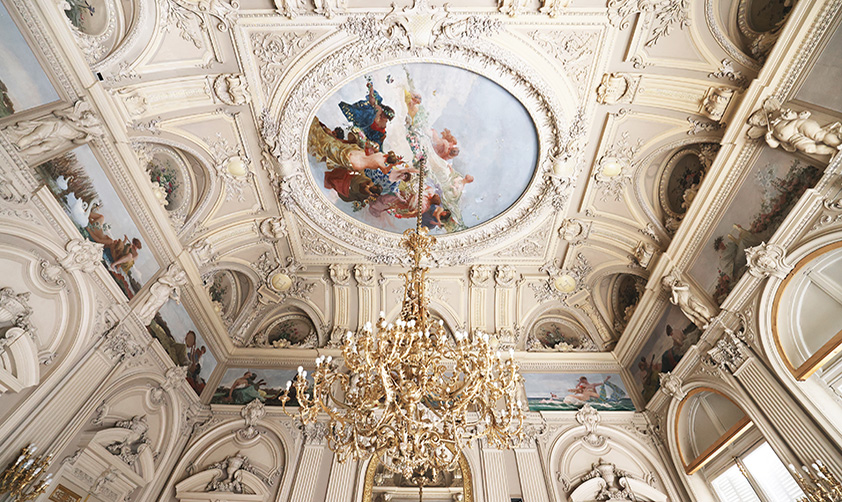

To mark International Museum Day 2026, whose theme this year is "Museums uniting a divided world", we have set up a photo gallery of Villa Hüffer, MUDEM's future headquarters. The story of Villa Hüffer is also a story about money and the international trade that money makes possible.
Wilhelm Hüffer was a German businessman who traded Cuban tobacco in France and is a perfect case in point. With the wealth he accumulated through his business, he had a city mansion built in Rome, which stands on Via Nazionale and will soon host MUDEM.
Villa Hüffer is a 19th century Roman mansion. It was built in the early 1880s and very soon became a favoured venue for the social life of Roman high society, largely centred around concerts and balls held at private residences. This atmosphere is captured in a lively article by the young Gabriele D'Annunzio, which came out on 26 January 1885 in the Roman daily newspaper La Tribuna, where D'Annunzio recounts a party the Hüffers had thrown the previous night in their mansion's ballroom. Carnival was in full swing in Rome and high society gathered at the dances held by the nobility and the upper classes. D’Annunzio describes the halls of Villa Hüffer, as well as the gowns worn by the attending dames, countesses and princesses:
This residence on Via Nazionale, with its gay and stately exteriors, was built according to a design by a French architect and the advice of Madame Hüffer, who managed to couple the varied elegance of its architectural forms with the most exquisite home comfort.
Madame Hüffer, born Costanza Grabau, was the daughter of a Tuscan banker of German descent. Wilhelm Hüffer, who often travelled to Rome on business, met her there - when Rome was not yet the capital of the Kingdom of Italy. His visits to the city became more frequent after 1848, until they decided to have their residence built on Via Nazionale. The couple finally settled into their new home in 1883.
As a family with ties to Germany, Tuscany, France and England, the Hüffers embodied a deeply European dimension, which is what makes Villa Hüffer a lot more than merely a historic Roman dwelling: it springs from a meeting of people, cultures, and international networks and trade. The premises a museum "inhabits" are a part of the heritage, alongside the collections they hold.
Have a look at these period photographs of the Villa, presumably taken in the 1920s and '30s, and welcome to the Hüffers'!