
If we want money to work and to be used both to buy goods and to set aside and retain the value of wealth accumulated over time, it has to be based not on one person's trust, but on everyone's trust. The value of money was born from this interplay of mutual trust, but this can also lead to the temptation to take advantage of it, in the form of counterfeiting. Some 12th-century episodes show how much money depended on trust and how this trust could lead to the possibility of fraud.
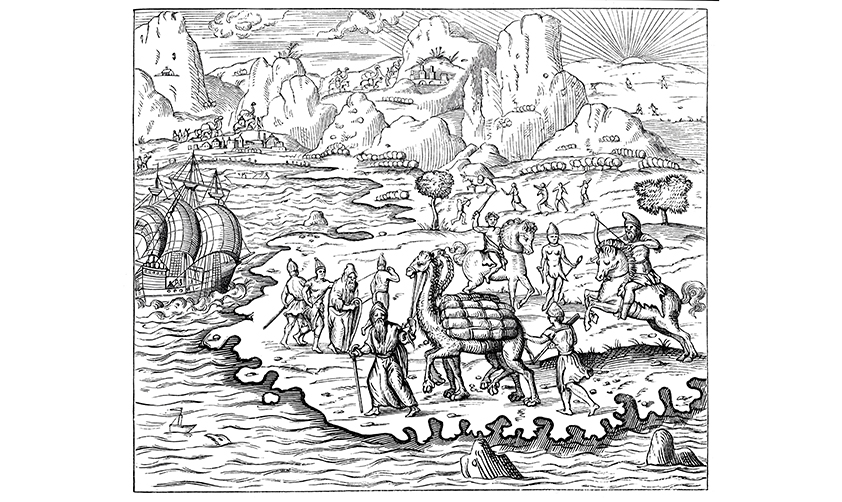
At that time, Christian Europe bought many goods produced in Africa, more than Africa bought from Europe. As historian Peter Spufford writes in his book on medieval money, 'Nomadic shepherds, from the Atlas Mountains to Libya, supplied Europeans with large quantities of skins and wool. For example, the important tanning industry in Pisa was heavily dependent on North African leather. The beekeeping of present-day Algeria provided honey and, more specifically, beeswax, in such large quantities that Bougie, the main port in this region, gave its name to wax candles in French (Bougie)' (Spufford, 1988, p. 171).
Europe produced a lot of silver in those centuries, while Africa was rich in gold. This difference resulted in the two metals having different values on the two sides of the Mediterranean: Europe needed more silver than was needed in Africa to obtain the same amount of gold, and this is why European merchants used silver to pay for goods from North Africa.
That flow of precious metals not only made exchanges between the two shores of the Mediterranean possible, but also ended up creating the conditions for a fascinating episode: a particular form of currency counterfeiting. In the territories governed by the Almohads – a Muslim dynasty that controlled much of the Maghreb and Spain – the silver was coined in square coins called dirhams and half dirhams. Europeans called them millares, miliarenses, miliaresi or miglioresi. As early as the mid-13th century, in addition to silver bullion for payments, some European merchants began to carry counterfeit miliaresi with them, coins that were made in secret in the shape of dirhams, close to their home port, to be spent in trade.
There was a religious message etched on the counterfeit coins: 'There is no God but Allah and Muhammad is his messenger'. It is curious that, as Harari notes, 'God-fearing Christians had no problem using these coins', despite the blasphemous words. 'Christians and Muslims, who could not agree on faith, could share another faith, however: that in money. Because, where religion asks us to believe in something, money asks us to believe that other people believe in something' (Harari, 2019).
Everyone believing in the same thing also means people trusting one another. Money isn't worth something because of what it's made of, but because of the trust it inspires in the communities where it circulates. It doesn't matter whether it is made of cowrie shells, cigarettes (as was the case in concentration camps) or a little metal disc with drawings and inscriptions: the materials just give trust a physical form. Trust, however, remains a psychological and social fact. It is precisely in this area, where materials take on a social meaning, that deception can arise. Falsification creeps in where trust is strong enough to sustain the value of coins, including counterfeit ones.
The 12th-century mints of Christian Europe could imitate the dirhams, in the form of miliares, precisely because their trading partners on the other side of the Mediterranean trusted that those square coins would be accepted by everyone. It's a trust that involves everyone: we are willing to work, flip burgers on a grill, sell health insurance or babysit three lively children, in exchange for pieces of coloured paper, only if – as Harari writes – 'we have faith in the inventions of our collective imagination. Trust is the raw material from which all kinds of money are coined' (Harari, 2019, p. 227).
In this sense, telling the story of forging money means dealing not only with materials – metal and paper – but also with psychology and politics. It is a history on the one hand of technology, metal alloys, chemistry and physics, and on the other hand, of something more subtle: collective trust, the 'public faith' that law considers as an asset that is violated by counterfeiters. A history of counterfeiting must ultimately link together metal and trust, technical aspects and social life, and science and legitimacy. Fakes are not just an economic crime, but an offence to the invisible network of beliefs that upholds the value and function of money. For this reason, the history of falsification is not just a list of frauds and deceptions: it also holds up a mirror to societies that produce and use money, and to how they build and convey confidence.
Bibliography
Harari Y.N. (2017), Sapiens. A Brief History of Humankind, Vintage
Spufford P., (1988), Money and its use in Medieval Europe, Cambridge University Press.